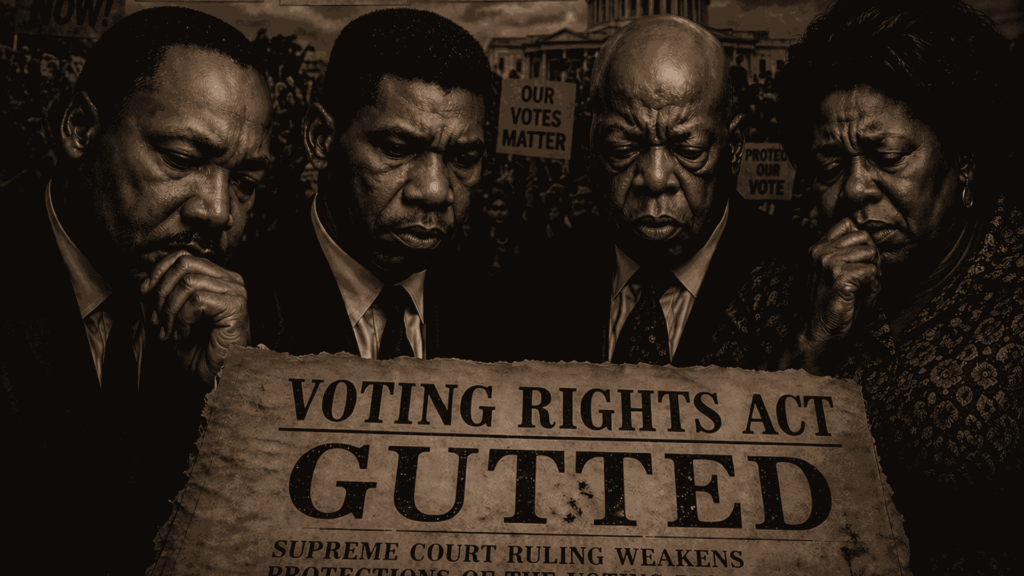
This moment is surreal as I literally grieve the Supreme Court’s near destruction of Section 2 of the Voting Rights Act of 1965, essentially gutting the VRA. In 2013, the Court destroyed the preclearance system that required states with a record of voter suppression to obtain federal approval before enacting new voting laws. That ruling, Shelby County v. Holder, technically struck down the coverage formula in Section 4(b) that identified which states were subject to preclearance under Section 5, rendering Section 5 entirely unenforceable without explicitly striking it down. Now, with Wednesday’s decision in Louisiana v. Callais, the conservative majority has finished the work it began over a decade ago. We have used Section 2 of the VRA to fight against racial gerrymandering, which involves grouping or spreading racial populations in ways that dilute their political power and give white voters the structural advantage.
White conservatives have destroyed the most important piece of legislation since the Reconstruction Amendments. It took them only 61 years. The leaders and activists of the Civil Rights Movement deserve an apology. Our enslaved ancestors deserve an apology. In this article I answer the question of how we arrived here.
How This Happened
Let’s begin with some facts. Black Americans never fully leveraged the Voting Rights Act. Black voting participation since the Act was enacted has been lackluster at best. Our voting percentage has exceeded that of whites on only two occasions, both driven by the historic candidacy of Barack Obama. Black voter turnout surpassed white turnout in 2008 and again in 2012, when Obama was reelected. Outside of those two elections, Black turnout has consistently trailed white turnout by significant margins, reaching a gap of more than 12 percentage points in both 2016 and 2020. Otherwise, we have treated the Act with too little urgency.
The reasons for Black Americans not fully embracing the VRA are many but several stand out.
First, one’s socioeconomic status seems determinative of one’s voting enthusiasm. Black Americans facing hard, sustained poverty view voting as unrelated to their plight. These brothers and sisters are often referred to as grassroots Blacks. Their political cynicism is rooted in a simple question: how is voting going to put food on my table? How will it put money in my pocket or a roof over my family’s head?
Second, and this reason is related to the first, politicians often promise what they don’t or can’t deliver and show up only during election season. Hence, when grassroots Blacks vote they see very little actual and immediate return for their votes. That’s because their instincts about many politicians are accurate: they only want votes. Other politicians, however, are sincere in their desire to better the lives and communities of their constituents. Nevertheless, there are economic and political realities that limit a politician’s ability to change conditions on the ground in their districts or states. In other words, the grassroots often fail to understand that voting alone is not enough. Systemic racism is a barrier to Black progress. Additionally, one’s personal behavior plays a significant role in one’s life, obviously.
Third, the political cynicism of the grassroots is often the devil’s playground. It provides a wide-open door for white and Black conservatives and their allies to exploit. This marriage of grassroots political cynicism, white conservatism, Black sellouts, and the reach of social media is a potent weapon used to mislead millions of Black Americans. These cynical Blacks are vulnerable to political disinformation that says voting is irrelevant, Democrats are using you for votes, they’re as racist as the GOP, civil rights are meaningless, and so forth; thus your political disengagement is righteous unless they give you reparations. The result is that millions of eligible Black voters don’t register and, consequently, don’t vote. That is precisely what white conservatives desire. When millions of Black Americans are not voting, white conservatives are free to elect their tribe throughout government and implement their agenda with little resistance.
Fourth, the Black community complains of political exhaustion and is resting. The defeat of Kamala Harris and the reelection of Donald Trump took their toll. Consequently, many Blacks have clocked out of the political process and are attempting to decompress. This political inactivity is also encouraged by the same influential Black content creators who are intentionally or unintentionally aligned with MAGA. However, I would argue this so-called resting is really retreating. Resting contemplates relaxing, and how can Black Americans relax while white conservatives gut civil and voting rights? The Black community has retreated, and it must stop, lest we risk further invalidation of Black rights.
How To Fix It
As far back as 2015, I warned Black America that Trump was dangerous to Black progress. But Trump has something very few white politicians have. Although deeply racist, he has a friendly relationship with many influential Black rappers, athletes, and entertainers. He has the support of many influential Black clergy, especially those who have abandoned the Black church’s prophetic voice. The Black church must reclaim that mantle to prevent becoming a tool of white supremacy.
We suffered a setback, but we will not stop advancing. The Supreme Court does not have the final word. Christ does. And practically speaking, Congress does. But we cannot make the mistake of not voting impactfully ever again. If Black Americans engage in impact voting, we can give the Democrats the majority in the House and the necessary 60 votes in the Senate to restore the VRA, even if Trump vetoes the legislation.